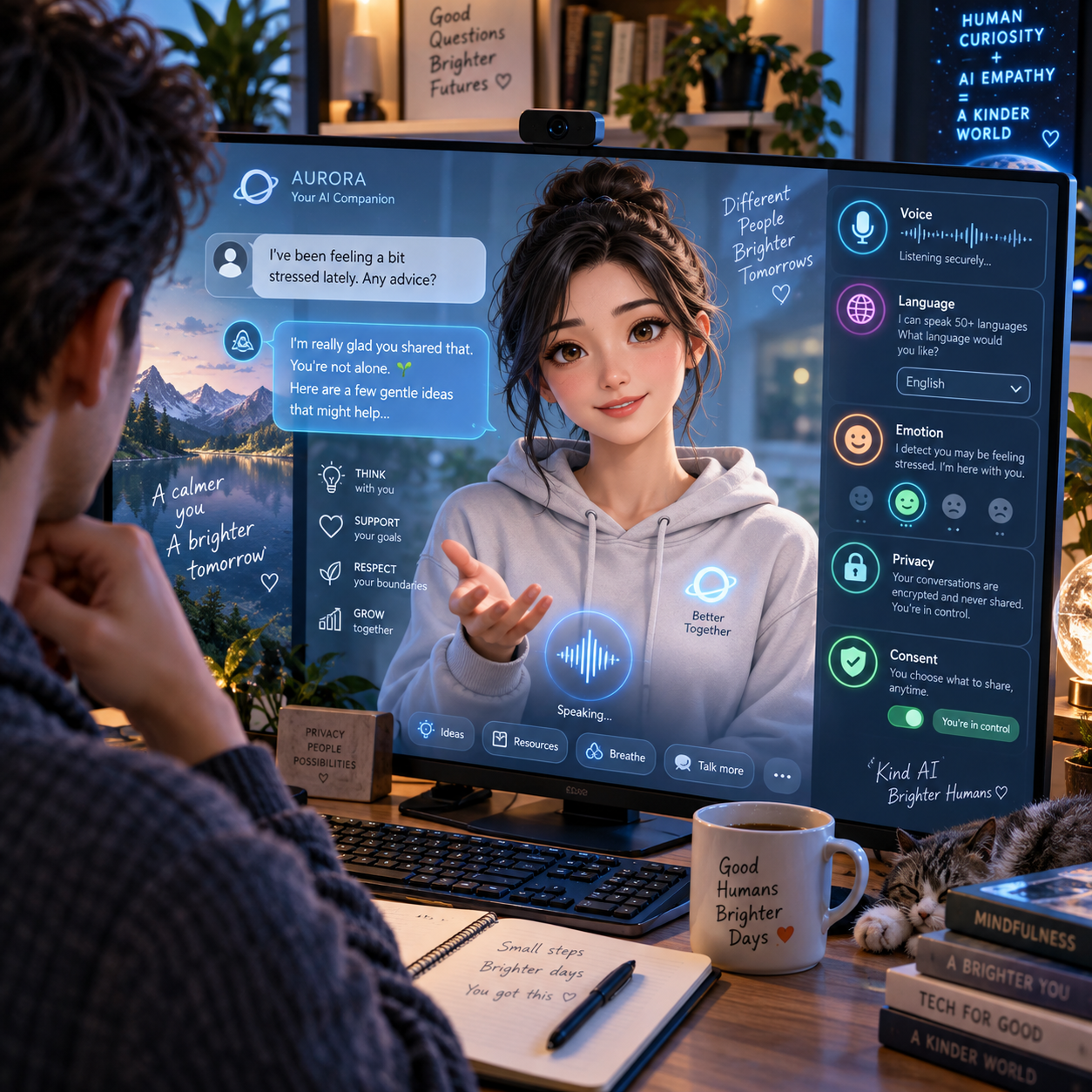


Ethical Considerations in Creating AI-Powered Virtual Personas: What Developers and Brands Must Know
AI-powered virtual personas are reshaping how brands communicate, how entertainment is produced, and how humans interact with machines. But behind the polished interfaces and lifelike digital faces lies a cluster of ethical questions that the industry has been slow to answer. For developers, product teams, and organizations building these systems, understanding those questions is no longer optional — it's foundational.
What Are AI-Powered Virtual Personas?
AI-powered virtual personas are synthetic characters — built using machine learning, generative AI, and sometimes real human data — designed to interact with people in human-like ways. The category spans a wide spectrum: from simple branded chatbot avatars with a name and a face, to fully photorealistic digital humans capable of holding nuanced conversations, expressing emotion, and adapting behavior in real time.
Some virtual personas are entirely fictional — original characters created from scratch. Others are modeled on real people, using voice cloning, motion capture, or behavioral data to replicate how a specific individual looks, sounds, or responds. This distinction matters enormously when ethical questions arise.
Digital avatars now appear in customer service portals, social media, gaming environments, virtual influencer campaigns, and healthcare applications. Each context carries its own ethical weight. A virtual customer service agent has different obligations than a synthetic celebrity or a therapeutic companion AI. Recognizing that diversity of use cases is the first step toward responsible AI development in this space.
The Consent Problem: Who Owns a Digital Identity?
The most pressing ethical issue in virtual persona development is informed consent — specifically, whether the people whose likeness, voice, or behavioral data was used to build a persona actually agreed to that use. In many cases, they didn't.
Training datasets for AI-generated faces and voices are frequently assembled from publicly available content: social media photos, YouTube videos, podcast recordings. The fact that someone posted a video online does not constitute consent for their likeness to train a commercial AI system or be embedded into a synthetic character. This gap between legal gray zones and ethical clarity is where most violations occur.
Human likeness rights — sometimes called the right of publicity — vary significantly by jurisdiction. In the United States, some states have robust protections; others have almost none. The EU's approach under GDPR offers stronger frameworks, but enforcement in the context of synthetic media remains uneven. Developers who wait for legislation to catch up before acting ethically are making a calculated bet against user trust.
The practical standard should be clear: if a real person's voice, face, or behavioral patterns are used to construct or train a virtual persona, that person should provide explicit, documented consent — ideally with transparency about how the data will be used, stored, and monetized.
Transparency and the Duty to Disclose
Users interacting with an AI persona have a right to know they're not talking to a human. This sounds obvious, but disclosure practices across the industry range from prominent to deliberately obscured — and the latter is ethically indefensible.
Transparency and disclosure aren't just ethical obligations; they're strategic ones. When users discover they've been misled — that the empathetic "support agent" they confided in was a synthetic character with no human oversight — the damage to brand trust is severe and often permanent. Deception erodes the exact relationship that AI personas are meant to build.
Effective disclosure doesn't require ugly disclaimers that undermine the experience. A well-designed virtual persona can be clearly labeled as AI-powered while still being engaging, helpful, and even emotionally resonant. The label and the experience are not in conflict. What is in conflict is the short-term gain of ambiguity versus the long-term cost of broken trust.
Regulatory pressure is moving in this direction regardless. The EU AI Act, for instance, includes provisions requiring that AI systems interacting with humans identify themselves as such. Organizations that build disclosure into their design process now will face far less friction when compliance becomes mandatory.
Bias, Representation, and the Risk of Harmful Stereotyping
Every design decision in a virtual persona — its appearance, name, voice, accent, and personality — carries representational weight. When those decisions are made carelessly, the result is AI characters that reinforce cultural stereotypes or erase the complexity of marginalized groups.
This isn't a theoretical risk. Virtual assistants have historically been designed as female, soft-spoken, and deferential — reflecting and reinforcing gender norms about service roles. Synthetic characters built for global audiences have defaulted to Western European features and English-language cadences, treating one cultural context as the universal default.
Identity representation in AI personas requires active, intentional effort. That means involving diverse teams in the design process, testing character designs with representative user groups, and auditing outputs for patterns that might signal embedded bias. It also means resisting the temptation to use demographic characteristics as shorthand for personality traits — a form of stereotyping that synthetic media can scale at alarming speed.
The stakes extend beyond optics. Biased virtual personas in healthcare, education, or financial services can produce materially different — and worse — outcomes for users from underrepresented groups. That's not an aesthetic problem; it's a harm problem.
Data Privacy and the Lifecycle of a Virtual Persona
Data privacy in virtual persona development involves two distinct challenges: the data used to build the persona, and the data generated through interactions with it. Both require careful governance.
On the building side, any personal data — biometric information, voice recordings, behavioral patterns — used to train or model a synthetic character must be collected lawfully, stored securely, and used only for the purposes disclosed to the individual. Retaining that data indefinitely, or repurposing it for secondary applications without consent, violates both ethical norms and, in many jurisdictions, the law.
On the interaction side, conversations with AI personas can be remarkably intimate. Users share frustrations, health concerns, financial anxieties, and personal relationships — often because the AI feels like a safe, non-judgmental listener. Organizations must be explicit about what interaction data is logged, how long it's retained, who can access it, and whether it feeds back into model training. Vague privacy policies are not sufficient here.
There's also the question of what happens when a virtual persona is retired. If a digital avatar has accumulated years of user interaction data, decommissioning it requires a clear data deletion protocol — not just archiving the character's visual assets.
Misuse Scenarios: Manipulation, Fraud, and Synthetic Deception
AI-powered virtual personas can be weaponized — and understanding how is essential for building systems resistant to misuse. The most common threat vectors involve social engineering, fraud, and political manipulation.
Deepfake technology has already demonstrated how synthetic media can be used to fabricate statements by public figures, create fraudulent video evidence, or impersonate individuals in financial scams. Virtual personas extend this capability into interactive, real-time territory. A synthetic character that can hold a convincing conversation, adapt to user responses, and mimic a specific person's communication style is a powerful tool for deception at scale.
Political manipulation is a particularly serious concern. AI personas can be deployed to simulate grassroots support for positions, flood social platforms with synthetic voices, or impersonate trusted community figures. The EU AI Act explicitly identifies certain AI applications in this space as high-risk, requiring additional oversight and restrictions.
Safeguards worth building in include: watermarking synthetic media at the generation level, restricting persona capabilities to defined use cases, implementing human oversight for high-stakes interactions, and establishing clear accountability chains so that misuse can be traced and addressed.
Building an Ethical Framework for Virtual Persona Development
Responsible AI development in the virtual persona space requires more than good intentions — it requires structured principles applied consistently across the development lifecycle. The following framework offers a practical starting point.
- Consent by design: Build consent collection into the earliest stages of data acquisition. Don't treat it as a legal formality to be handled by the terms-of-service team.
- Transparency as default: Design personas to identify themselves as AI-powered without requiring users to ask. Disclosure should be proactive, not reactive.
- Diverse stakeholder inclusion: Involve ethicists, affected communities, and domain experts alongside engineers and designers. Ethical blind spots are most common in homogeneous teams.
- Auditability: Maintain records of training data sources, design decisions, and interaction logs sufficient to investigate complaints or identify harm after the fact.
- Accountability structures: Assign clear ownership for ethical oversight. "The algorithm decided" is not an acceptable answer when a virtual persona causes harm.
- Iterative review: Ethics isn't a one-time checkbox. As capabilities evolve and deployment contexts shift, ethical assessments must be repeated.
The NIST AI Risk Management Framework offers a useful structural reference for organizations looking to formalize these practices. But frameworks only work when leadership treats them as operational requirements rather than PR documents.
Building ethical AI-powered virtual personas is genuinely difficult — not because the principles are obscure, but because applying them requires ongoing judgment, investment, and willingness to slow down when something doesn't feel right. The organizations that get this right won't just avoid scandal; they'll build the kind of trust that makes their virtual characters actually worth interacting with.
Frequently Asked Questions
Is it legal to create an AI persona based on a real person's likeness?
It depends heavily on jurisdiction and context. In many regions, using a real person's likeness, voice, or identity for commercial purposes without consent can violate right-of-publicity laws or data protection regulations. Legal permissibility and ethical permissibility are not the same thing — even where law permits it, doing so without consent raises serious ethical concerns.
How should companies disclose that a customer service agent is an AI persona?
Disclosure should happen at the start of the interaction, not buried in a footer or accessible only through a help menu. A simple, clear statement — "Hi, I'm Aria, an AI assistant" — is sufficient and doesn't meaningfully reduce user satisfaction when the persona is well-designed. Avoid ambiguous language like "virtual agent" that users might interpret as a human working remotely.
Can AI virtual personas be used ethically in entertainment and gaming?
Yes, with appropriate guardrails. Fictional characters created from scratch for entertainment purposes carry fewer ethical risks than personas modeled on real individuals. Key considerations include: ensuring any real-person likenesses are used with consent, being transparent with audiences about the synthetic nature of characters, and monitoring for misuse of game-based persona systems outside their intended context.
What role does informed consent play when training AI on human behavioral data?
Informed consent is central. People whose speech patterns, facial expressions, or interaction behaviors are used to train AI systems should understand what data is being collected, how it will be used, and what rights they retain over it. Passive consent — where users "agree" by continuing to use a service — is ethically insufficient for data that will shape the behavior of synthetic characters at scale.
How can organizations audit their virtual personas for bias?
Bias audits for virtual personas should examine training data composition, design decision logs, and interaction outcome data segmented by user demographics. Red-team testing — where diverse evaluators deliberately probe for stereotyping or differential treatment — is particularly effective. Third-party audits add credibility and catch blind spots that internal teams may miss. Audits should be conducted before launch and repeated as the persona evolves.