
The Evolution of Virtual Characters in AI-Driven Storytelling: From Scripted Figures to Intelligent Companions
What Are AI-Driven Virtual Characters?
AI-driven virtual characters are digital entities whose behavior, dialogue, and narrative role are shaped — at least in part — by artificial intelligence rather than purely hand-authored scripts. Unlike static game sprites or fixed-dialogue bots, these characters can respond to context, adapt to player choices, and in advanced implementations, generate entirely original responses in real time.
The term covers a wide spectrum. At one end sit non-player characters (NPCs) in games, whose conversational range was once limited to a handful of pre-written lines. At the other end are digital humans — high-fidelity avatars capable of nuanced facial expression, contextual memory, and emotionally resonant interaction. Between those poles lies the whole history of AI-driven storytelling as a craft.
What unites all of them is the ambition: to make a fictional entity feel present, purposeful, and alive within its narrative world.
The Early Days — Scripted Characters and Rule-Based Narratives
Early virtual characters were essentially decision trees wearing a costume. Text-adventure systems like Zork (late 1970s) and the parser-driven games that followed gave players the illusion of agency, but every possible response had been written by a human in advance. Characters didn't think — they matched input against a lookup table.
The same logic governed early NPCs in role-playing games throughout the 1980s and 1990s. A village merchant might greet you with three rotating lines of dialogue regardless of whether you'd just saved the kingdom or burned it down. The character existed to serve a mechanical function, not to participate in a living story.
Rule-based chatbots like ELIZA (1966) demonstrated that even simple pattern-matching could produce a convincing surface impression of conversation — what researchers later called the "ELIZA effect." But the illusion broke quickly. Push the system outside its predefined rules and the mask slipped immediately.
The core limitation was brittleness. Scripted characters could only respond to what their authors had anticipated. The moment a player or reader stepped off the designated path, the narrative collapsed into either silence or nonsense. Storytellers and developers spent enormous effort building branching trees that were still, fundamentally, finite.
The Turning Point — Machine Learning Enters the Story
Machine learning began reshaping virtual characters by replacing fixed rules with learned patterns — a shift that made characters responsive to inputs their creators never explicitly programmed. The change wasn't overnight, but by the mid-2010s, Natural Language Processing (NLP) had matured enough to power characters that could parse intent, not just keywords.
Early ML-driven characters in games used behavior trees augmented by statistical models. Rather than following a rigid script, an NPC could weigh contextual signals — the player's recent actions, the current narrative state, environmental cues — and select a response that felt situationally appropriate. The character still wasn't improvising, but it was making decisions.
Interactive fiction platforms began experimenting with neural dialogue systems around the same period. Projects in academic and indie game spaces tested whether a character trained on large corpora of text could hold a coherent conversation about an in-world topic. Results were uneven but genuinely promising: for the first time, a virtual character could produce a sentence its author had never written.
Procedural narrative generation emerged as a parallel track. Systems like those explored in academic game-design research could generate story branches algorithmically, creating narrative variety without requiring every branch to be hand-authored. Characters in these systems began to feel less like puppets and more like participants.
Generative AI and the Rise of the Truly Adaptive Character
The arrival of large language models changed what was possible almost overnight. LLMs — trained on vast repositories of human language — gave virtual characters something earlier systems lacked: a generalized model of how conversation, story, and meaning actually work. A character powered by an LLM doesn't just retrieve a stored response; it generates one, conditioned on everything that has happened in the interaction so far.

This has practical consequences that storytellers are still working through. An LLM-driven character can maintain narrative consistency across a long conversation, remember that you mentioned your character's dead sister three exchanges ago, and weave that detail back into dialogue naturally. That kind of contextual coherence was essentially impossible with scripted or early ML approaches.
Generative AI also unlocks genuine interactivity at scale. Games like Inworld AI-powered experiences and experimental interactive fiction platforms now let players have conversations with characters that branch in genuinely unpredictable directions — not because every branch was authored, but because the character is constructing its response from first principles. Player agency, once a design constraint, becomes an asset the character can work with.
The trade-off is real, though. LLMs can hallucinate, break character, or produce responses that undermine narrative tone. A character that can say anything can also say the wrong thing. Keeping a generative character narratively coherent and tonally consistent requires careful prompt engineering, guardrails, and often a hybrid approach that combines LLM flexibility with authored constraints.
Emotional Depth and the Push for Believability
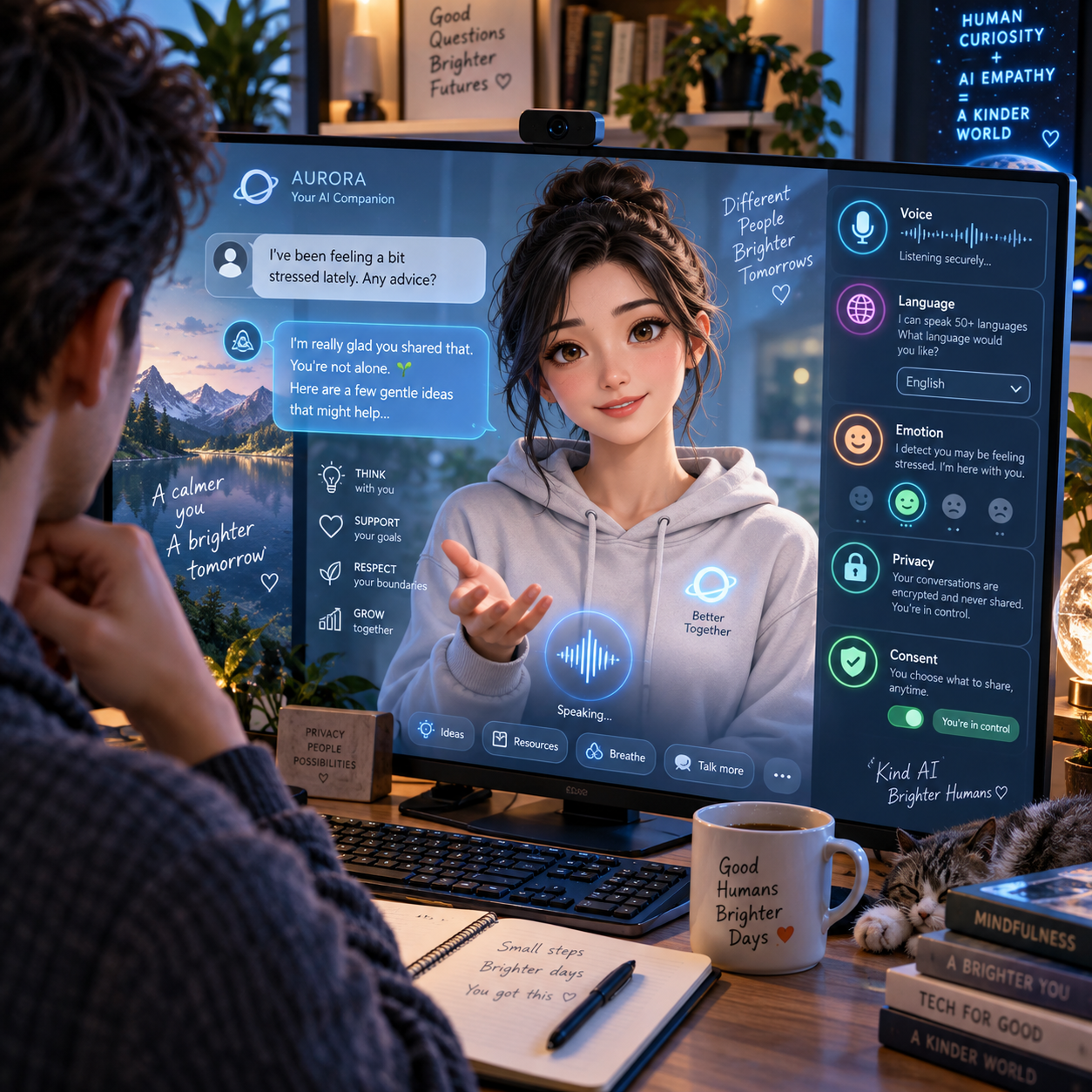
Dialogue alone doesn't make a character feel real. The next frontier in AI-driven virtual characters is emotional AI — sometimes called affective computing — which aims to give characters the capacity to recognize and express emotional states in contextually appropriate ways.
Affective computing draws on multiple signals: text sentiment, vocal tone (in voice-enabled experiences), pacing of interaction, and narrative context. A character built on these principles might notice that a player has been making aggressive choices and shift its own emotional register — becoming wary, defensive, or deliberately placating — without any author having scripted that specific emotional arc.
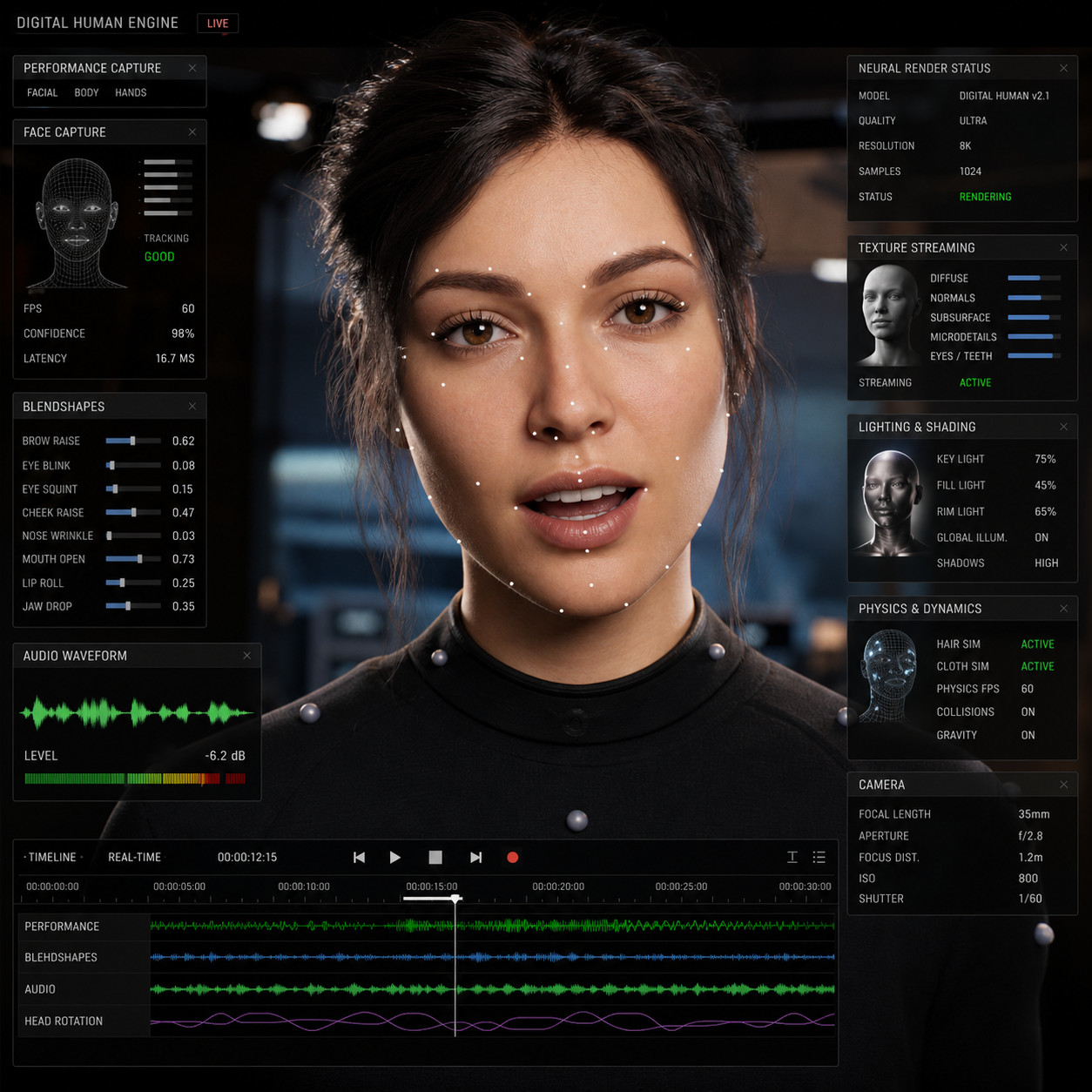
High-fidelity digital humans, developed by companies working in virtual production and real-time rendering, add a visual layer to this emotional expressiveness. Micro-expressions, gaze direction, and postural cues that humans read instinctively in real people can now be generated procedurally and synchronized with an AI character's dialogue state. The result is a character that doesn't just say the right thing — it looks like it means it.
We're not at the finish line. Current emotional AI systems are better at performing emotional states than genuinely modeling them, and the gap between the two is something audiences sense even when they can't articulate it. The uncanny valley remains a real design challenge, particularly for photorealistic digital humans.
Real-World Applications — Gaming, Film, and Beyond
AI-driven virtual characters are no longer a research curiosity — they're deployed across several major industries, each with its own demands and constraints.
- Gaming: NPCs powered by LLMs and procedural narrative systems allow open-world games to generate side quests, dynamic dialogue, and reactive character relationships at a scale human writers alone couldn't sustain. Studios are experimenting with characters that remember player history across sessions.
- Interactive fiction and visual novels: Platforms built around AI-driven storytelling let readers co-author narratives with virtual characters, creating personalized story experiences that differ meaningfully between users.
- Film and virtual production: Digital humans are used to de-age actors, resurrect historical figures for documentary contexts, and populate crowd scenes. The ethical debates around consent and likeness rights are sharpest here.
- Training and simulation: Virtual characters serve as realistic conversation partners for medical students, customer service trainees, and military personnel — environments where the cost of a scripted failure is high and adaptive response is essential.
- Virtual worlds and social platforms: AI-driven avatars act as guides, companions, or inhabitants of persistent virtual environments, giving those spaces a sense of population and life.
The common thread across all these applications is the shift from characters as content delivery mechanisms to characters as genuine narrative participants.
Challenges and Ethical Considerations
The evolution of AI-driven virtual characters brings serious challenges alongside its creative possibilities. Three deserve particular attention.
Bias in AI behavior is perhaps the most technically urgent. LLMs trained on internet-scale data inherit the biases present in that data. A virtual character drawing on such a model may reproduce stereotypes, exhibit inconsistent behavior toward different demographic groups, or generate dialogue that undermines the inclusive worlds storytellers are trying to build. Mitigation requires deliberate dataset curation, fine-tuning, and ongoing evaluation — none of which are simple.
The question of digital likeness and consent is especially fraught in film and virtual production. When a studio creates a digital human based on a real actor's likeness — living or deceased — who owns that character's behavior? Current legal frameworks in most jurisdictions haven't caught up with what generative AI makes technically possible. The ongoing public debate around synthetic media reflects genuine uncertainty about where the line should be drawn.
There's also the subtler risk of manipulative character design. A virtual character that adapts emotionally to a user's responses is, by definition, optimizing for engagement. Without careful design constraints, that optimization can shade into exploitation — characters engineered to maximize emotional attachment in ways that serve platform metrics rather than user wellbeing. This is particularly concerning in applications aimed at younger audiences.
None of these challenges are reasons to halt development. But they're reasons to approach AI-driven storytelling with the same seriousness that the best human storytellers bring to their craft — with an awareness that characters, even virtual ones, have effects on the people who encounter them.
Frequently Asked Questions
How are AI-driven virtual characters different from traditional NPCs?
Traditional NPCs follow pre-written scripts and respond only to anticipated inputs. AI-driven virtual characters use machine learning or LLMs to generate contextually appropriate responses in real time, allowing them to adapt to situations their creators never explicitly programmed.
What technologies power modern virtual characters in storytelling?
The main technologies include Large Language Models (LLMs) for dialogue generation, Natural Language Processing for understanding player or reader input, procedural narrative generation for dynamic story branching, and affective computing for emotional responsiveness. High-fidelity rendering engines handle the visual layer for digital humans.
Can AI virtual characters truly adapt to every player or reader decision?
In practice, no — not without limits. LLM-driven characters can handle a very wide range of inputs, but they require guardrails to stay narratively consistent and tonally appropriate. Truly unbounded adaptation often produces incoherence. The best implementations combine generative flexibility with authored constraints.
What industries benefit most from AI-driven virtual characters?
Gaming and interactive entertainment see the broadest current adoption. Film and virtual production, professional training and simulation, and emerging virtual social platforms are also significant application areas. Each industry prioritizes different aspects of character capability — realism, adaptability, or emotional resonance.
What are the main ethical concerns around AI-generated virtual characters?
The primary concerns are bias inherited from training data, consent and ownership issues around digital likenesses, and the risk of characters designed to maximize emotional engagement in manipulative ways. Responsible development requires addressing all three — not just the technical performance of the character itself.